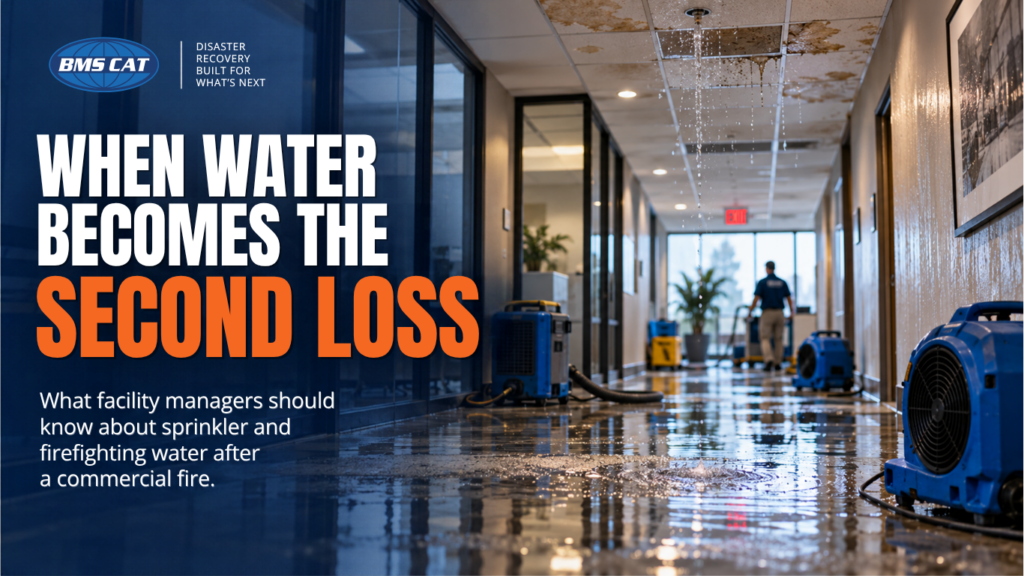
Fire sprinklers and firefighting operations play a critical life-safety role during a fire. After the incident, however, the water used to control the fire can become a second property-recovery challenge.
Facility managers may need to address water affecting ceilings, walls, floors, contents and building systems, even in areas with little or no direct flame damage.
That means commercial fire recovery often becomes a combined fire, smoke and water-loss project.
Planning ahead? Download the Commercial Fire Recovery Readiness Checklist(opens in new tab) and see whether your plan covers water, not just flames.
Why suppression water changes the recovery
After a fire, the facility team may initially concentrate on burned materials.
Water can extend the affected footprint.
Depending on conditions, it may reach:
- Flooring
- Drywall
- Ceiling assemblies
- Insulation
- Furniture
- Inventory
- Equipment
- Documents
- Lower floors
- Concealed building cavities
BMS CAT’s fire restoration process specifically includes water removal and drying when excess water results from firefighting efforts. Explore our commercial water damage restoration services for water extraction, drying and recovery coordination at your facility.
The operational issue is where the water went
The important question is not merely:
How much water is visible?
It is:
What materials, equipment and operations may have been affected?
Consider a sprinkler activation on an upper floor.
The fire itself may be localized, while water moves into ceiling assemblies or lower portions of the property.
- For a hotel, that could mean additional rooms out of service.
- For an office property, it could affect another tenant.
- For a school, it could affect classrooms below the incident.
- For a healthcare environment, additional spaces may need careful coordination before use.
- For manufacturing, water exposure may raise questions about equipment or inventory.
Start by mapping the affected areas
Once the property can be safely accessed by qualified professionals, determine:
- Where water was discharged
- Where it traveled
- What materials were affected
- Whether lower levels are involved
- Whether contents were affected
- Which building systems are nearby
- Which operating areas depend on those spaces
This helps the restoration team build a more complete drying and recovery strategy. For a broader look at how damage spreads, read Fire Damage Goes Beyond the Burn Area.
Separate life safety from property recovery
A crucial distinction:
Sprinkler systems exist to protect life and property during the fire.
The fact that water causes a recovery challenge afterward does not diminish their purpose.
The facility-management lesson is simply that organizations should plan for the secondary property consequences of successful fire suppression.
What facility teams can prepare in advance
Document:
- Fire protection system contacts
- Sprinkler contractor
- Facility shutoff information for authorized personnel
- Floor plans
- Utility information
- Mechanical/electrical rooms
- High-value contents
- Sensitive equipment
- Critical records
- Areas vulnerable to water
- Emergency restoration contact
Unqualified personnel should not manipulate fire-protection, electrical or mechanical systems during or following an emergency.
Document it once, with a team that will respond
Through the Priority Disaster Response Program, BMS CAT walks your facility with your team to document critical areas, systems and contacts so the response starts faster when it matters.
Recovery priorities after suppression water
A coordinated recovery may involve:
- Safety and access authorization
- Understanding the affected area
- Water extraction
- Moisture assessment
- Structural drying
- Contents evaluation
- Evaluation of affected systems or equipment
- Removal of unsalvageable materials where needed
- Repairs
- Documentation and reopening coordination
The sequence will vary depending on the facility.
Why this matters for business continuity
Consider the difference between physical damage and operational damage.
- One wet corridor might affect access to an entire department.
- One mechanical space could affect multiple tenants.
- One water-affected electrical area could have implications for otherwise undamaged operations.
Facility leaders should therefore prioritize recovery according to business dependencies, not just square footage.
Questions to ask before Fire Prevention Week ends
- Which areas would be most operationally sensitive to water?
- What critical equipment is located below sprinkler-protected areas?
- Are mechanical and electrical rooms clearly documented?
- Who is our fire-protection contractor?
- Who has authority over system decisions?
- Who will handle emergency water mitigation?
- Which operational areas would need to come back first?
- Do we have after-hours contact information?
Frequently Asked Questions
Can fire sprinklers cause water damage?
Water discharged during fire suppression can affect building materials and contents, creating a water-mitigation and drying need after the immediate emergency.
Can water affect areas outside the fire room?
Yes. Depending on building conditions and water movement, areas beyond the fire origin may require evaluation.
What happens to wet building materials?
Qualified restoration professionals can evaluate affected materials and determine appropriate drying, restoration or removal strategies based on conditions.
Should facility staff begin cleaning immediately?
Access and work should follow direction from emergency authorities and qualified professionals. Employees should not enter areas that have not been cleared.
Why should water recovery be part of a fire plan?
Because a facility fire may simultaneously create fire, smoke and water damage, all of which can affect business continuity.
Prepare for the Full Loss, Not Just the Flames
Good fire recovery planning considers what happens after the suppression system does its job.
Fire, smoke and water can create different recovery needs across a commercial property. Understanding those relationships before an emergency can help facility teams coordinate the response more effectively. For the full planning framework, read Commercial Fire Recovery Plan: What Facility Managers Should Have in Place Before a Fire.
Add water to your fire recovery plan
Use the Commercial Fire Recovery Readiness Checklist to document water mitigation, critical equipment and building-system information. For 24/7 emergency response, call 877.730.1948.