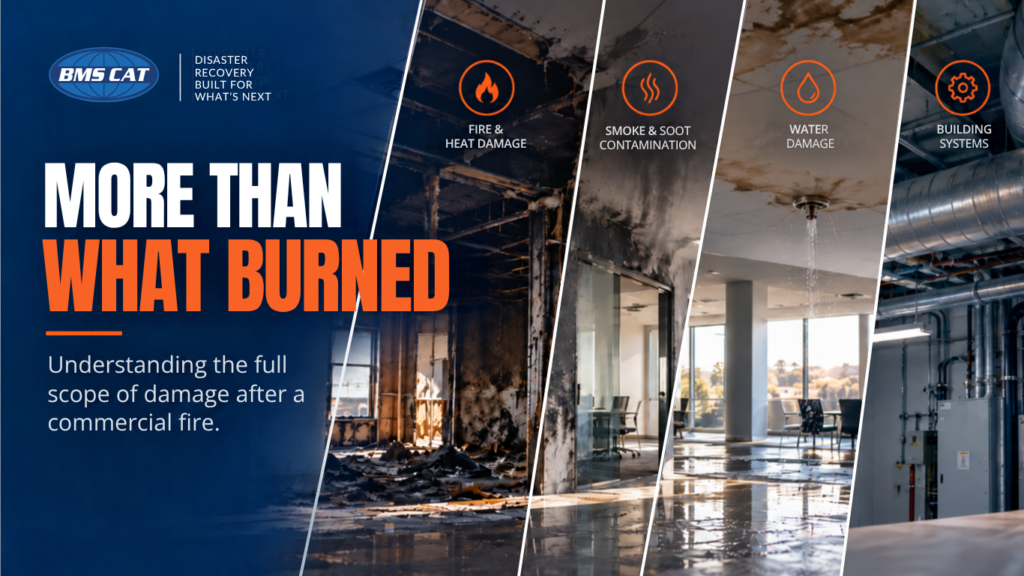
The area visibly burned during a commercial fire does not necessarily define the full scope of the loss. Smoke and soot can reach adjoining spaces, firefighting and sprinkler water can affect building materials and contents, and interconnected building systems may require evaluation before normal operations resume.
For facility managers, the important question is therefore not simply “What burned?”
It is:
“What else could this event have affected?”
Planning ahead? Download the Commercial Fire Recovery Readiness Checklist(opens in new tab) to see whether your plan accounts for more than the fire origin.
Four different forms of damage may need attention
1. Direct fire and heat damage
This is usually the most visible component:
- Burned structural materials
- Damaged finishes
- Melted components
- Heat-damaged equipment
- Compromised contents
But visibility makes this portion comparatively easy to identify.
The less obvious effects often create the harder operational questions.
2. Smoke and soot contamination
Smoke moves.
Depending on the building, event and mechanical conditions, residues may be found beyond the immediate fire area.
Facility teams may therefore need qualified professionals to evaluate:
- Adjacent rooms
- Corridors
- Ceiling plenums
- Air pathways
- Contents
- Equipment
- Mechanical systems
BMS CAT’s fire-restoration process specifically assesses smoke and soot conditions rather than limiting evaluation to direct flame damage.
3. Firefighting and sprinkler water
The systems and actions that control a fire can also create a second property challenge.
Water may affect:
- Drywall
- Ceilings
- Flooring
- Insulation
- Furniture
- Inventory
- Equipment
- Lower floors
- Concealed assemblies
BMS CAT includes water removal and structural drying when firefighting activity creates water damage.
From an operational standpoint, that means a room with no visible burn damage may still require attention.
4. Building systems
Commercial buildings are interconnected.
Evaluate how the event may have affected systems such as:
- HVAC
- Electrical
- Fire protection
- Elevators
- Communications
- Building automation
- Specialized process equipment
Facility personnel should coordinate these evaluations with appropriately qualified professionals rather than testing damaged systems themselves.
Why HVAC deserves particular attention
Commercial HVAC systems can connect multiple areas of a building.
BMS CAT notes that systems exposed to smoke or fire contamination should receive attention before returning to use because HVAC operation can redistribute pollutants when contamination is present. Learn more about HVAC decontamination.
This can make the operational footprint of a fire larger than its physical origin.
Questions for engineering teams include:
- What equipment served the affected area?
- Which other spaces share those systems?
- Was the equipment operating during the incident?
- What components require professional inspection?
- What conditions must be addressed before restart?
The biggest mistake: defining the loss too narrowly
If the recovery team looks only at the most visibly damaged room, it risks missing the interconnected nature of a commercial property.
Instead, assess the event in zones:
- Fire origin
- Adjacent spaces
- Spaces connected through building systems
- Water-affected spaces
- Critical operational areas
- Unaffected areas requiring protection
That last category matters.
Restoration is not only about fixing damage. It is also about preventing work in affected areas from unnecessarily disrupting spaces that remain usable.
Map your zones before a fire, not after
Through the Priority Disaster Response Program, BMS CAT walks your facility with your team to document critical areas, shared building systems and response priorities before an emergency happens.
What facility leaders should ask during the initial assessment
Ask:
- What areas are confirmed affected?
- What additional areas are being evaluated?
- What building systems connect to the fire area?
- Where did suppression water travel?
- Which contents or equipment need specialized evaluation?
- What can remain operational?
- What should remain isolated?
- What information is still needed?
- What are the biggest operational dependencies?
- What must happen before reopening decisions can be made?
Those questions move the conversation from cleanup to continuity.
Frequently Asked Questions
Can smoke damage rooms that did not burn?
Yes, smoke and residues may move beyond the fire’s immediate origin depending on the building and incident.
Can sprinklers create water damage?
Yes. Water used to suppress a fire may affect building materials, contents and other areas and can require extraction and drying.
Can HVAC spread smoke?
HVAC systems can be involved in the movement or redistribution of contaminants, which is why affected systems should be professionally evaluated before reuse.
Should facility teams inspect damaged equipment themselves?
Equipment potentially affected by fire, heat, smoke, soot or water should be evaluated by appropriately qualified personnel.
Why does secondary damage matter for business continuity?
Because areas or systems outside the visibly burned area may still affect whether operations can continue or resume.
Look Beyond the Burn Area
A commercial fire is rarely a single-damage event.
Understanding the combined effects of fire, smoke, soot, water and building-system impacts gives facility leaders a clearer picture of what recovery actually requires. For the planning side, read Commercial Fire Recovery Plan: What Facility Managers Should Have in Place Before a Fire.
Use Fire Prevention Week to review whether your emergency plan accounts for fire, smoke, suppression water and critical building systems, not simply the fire origin.
Is your plan ready for the full loss?
The Commercial Fire Recovery Readiness Checklist helps your team confirm contacts, authority, building systems and priorities are documented. For 24/7 emergency response, call 877.730.1948.