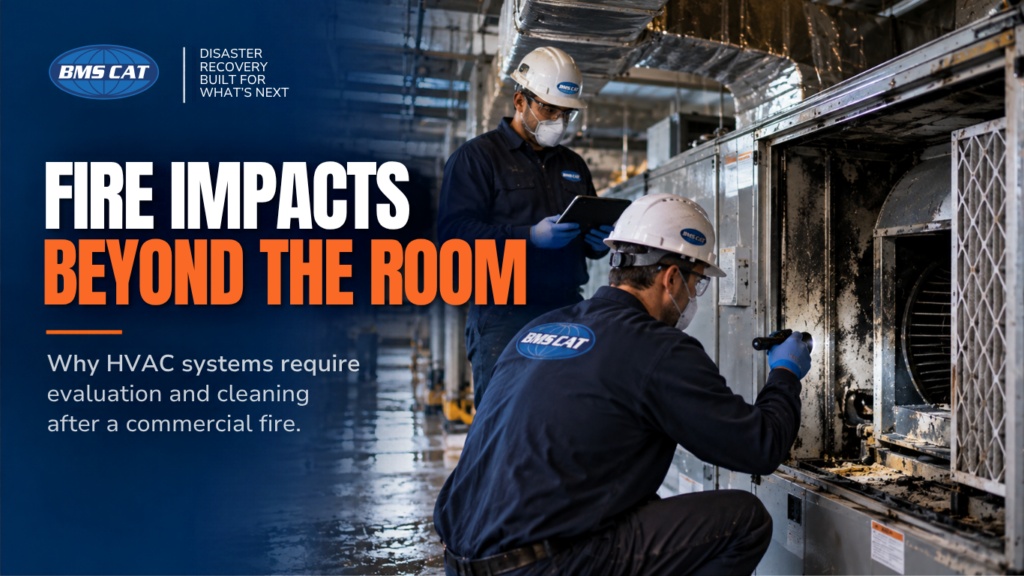
Yes. When smoke or fire-related contamination reaches a commercial HVAC system, components or ductwork may require professional evaluation and cleaning before the system returns to normal service. Because HVAC systems connect multiple areas of a facility, the concern can extend beyond the room where the fire occurred.
For an engineering or facilities team, the key issue is not simply whether smoke is visible.
It is understanding where the system serves, what may have been exposed and what needs evaluation before restart.
Dealing with smoke in your system now? Call BMS CAT 24/7 at 877.730.1948 or learn about our HVAC decontamination services.
Why HVAC changes the scope of a commercial fire
Commercial HVAC systems are designed to move air through buildings.
That becomes an important consideration after a fire.
Depending on system design and operating conditions, facility teams may need to evaluate:
- Air handlers
- Ductwork
- Supply and return pathways
- Filters
- Coils
- Registers
- Exhaust systems
- Associated mechanical components
BMS CAT’s HVAC decontamination guidance specifically identifies smoke and fire damage as conditions requiring attention before affected HVAC systems are put back into use.
Think in systems, not rooms
Suppose a fire affects one tenant suite.
The obvious response is to focus on that suite.
An engineering leader should also ask:
- Which air-handling system serves that space?
- What other areas does it serve?
- Was it running during the incident?
- Do adjacent floors or tenants share mechanical pathways?
That does not mean every connected space is contaminated.
It means the system relationship should be understood rather than ignored. For more on how damage travels, read Fire Damage Goes Beyond the Burn Area.
Why restarting too quickly can create problems
Facility teams are understandably eager to restore normal building conditions.
But equipment potentially affected by the incident should not simply be restarted without appropriate evaluation.
BMS CAT notes that HVAC decontamination can involve services such as duct cleaning, filter replacement, coil cleaning, odor control or, in some circumstances, more extensive equipment cleaning depending on the conditions identified.
The appropriate scope depends on the incident and professional assessment.
Get the system evaluated before restart
BMS CAT provides HVAC cleaning and decontamination for commercial properties affected by smoke and fire, from duct and coil cleaning to odor control.
Questions engineering teams should ask
After a commercial fire, gather the mechanical team and ask:
- Which air-handling systems served the affected space?
- What other areas are connected to those systems?
- Were those systems operating during the event?
- Were dampers or other controls activated?
- Are filters or components visibly affected?
- Does the system require specialized evaluation?
- What criteria will determine when it can be returned to service?
- How will any HVAC work affect occupied portions of the property?
These questions help connect restoration work to facility operations.
Vertical-specific considerations
Healthcare
HVAC decisions can intersect with sensitive clinical environments, containment requirements and continuity of care.
Hospitality
A system serving multiple guest floors or common areas can turn a localized incident into a broader operational concern.
Commercial real estate
Shared HVAC infrastructure can create questions involving multiple tenants and spaces.
Education
One mechanical system may serve classrooms, labs or administrative areas with very different reopening priorities.
Data centers
Cooling and environmental control are directly tied to continuity, making coordinated engineering decisions particularly important.
HVAC should be in the fire recovery plan before an incident
Document:
- Air-handler locations
- Areas served
- Mechanical-room access
- Critical systems
- Engineering contacts
- HVAC service vendors
- Shutdown/restart authority
- Building automation contacts
That information can be valuable when teams are working quickly to understand the scope of an event.
Frequently Asked Questions
Can smoke enter HVAC ductwork?
It can, depending on the fire, building configuration and operation of the system.
Should the HVAC system be restarted immediately after a fire?
Potentially affected HVAC equipment should be evaluated appropriately before being put back into service.
Does all ductwork automatically need cleaning after a fire?
No universal answer applies to every incident. The required scope should be based on actual conditions and professional assessment.
Can HVAC issues affect otherwise undamaged parts of a property?
Because commercial HVAC systems may serve multiple spaces, system relationships can be relevant to the broader damage evaluation.
Who should evaluate the system?
Use qualified HVAC, restoration and other appropriate professionals based on the incident and facility.
Think Beyond the Fire Room
When a fire occurs, engineering teams should understand not only where the flames were located but how the building’s mechanical systems connect that area to the rest of the facility.
BMS CAT provides HVAC cleaning and decontamination services for commercial properties affected by smoke and fire damage. If you are managing an active loss, see What to Do After a Fire in a Commercial Building.
Add HVAC to your emergency response plan
The Commercial Fire Recovery Readiness Checklist helps you document building systems, contacts and restart authority before you need them.